Managers Are Not the Delivery Channel for Every Organisational Ambition

The pressure rarely arrives as a strategy document.
It arrives as a manager trying to explain a decision they didn’t make, to a team that doesn’t quite trust the room, while a customer issue is waiting, a policy has changed, a new AI tool is being pushed, and someone in senior leadership has used the phrase “move faster” three times before lunch.
Nobody has shouted.
Nobody has failed.
But the room has narrowed.
The manager is now holding four things at once: the ambition from above, the confusion from below, the risk from the side, and the emotional weather of the room.
They are expected to translate, reassure, challenge, decide, protect standards and keep things moving.
This is where a lot of organisations are currently placing their operating model.
Inside one person.
Managers are becoming the pressure point
Gallup’s 2026 State of the Global Workplace reports that global employee engagement fell to 20% in 2025, its lowest level since 2020, with low engagement estimated to cost the world economy $10 trillion in lost productivity. Gallup’s wider reporting also shows the sharp pressure on managers, with manager engagement falling significantly faster than non-manager engagement in recent years.
That matters because managers are not a side issue.
They are where strategy becomes behaviour.
They are where a senior decision becomes a team conversation. They are where an AI adoption target becomes a question about judgement and risk. They are where a service promise becomes tone of voice under pressure. They are where legal change becomes a difficult conversation with a real person.
They are where “we need to move faster” becomes:
“What exactly can I decide?”
“What happens if this goes wrong?”
“And why am I the one explaining this?”
Most commentary calls this manager burnout.
Some of that is true. Managers are tired.
But tired is not the full pattern.
The sharper issue is this: managers are being asked to carry contradictions the operating model has not resolved.
Senior teams want pace. Employees want clarity. Customers want consistency. HR wants compliance. Technology teams want adoption. Operations wants fewer escalations. Finance wants discipline.
Everyone wants trust.
The manager is where those demands become a conversation at 10:07 on a Tuesday.
Small room. Big load.
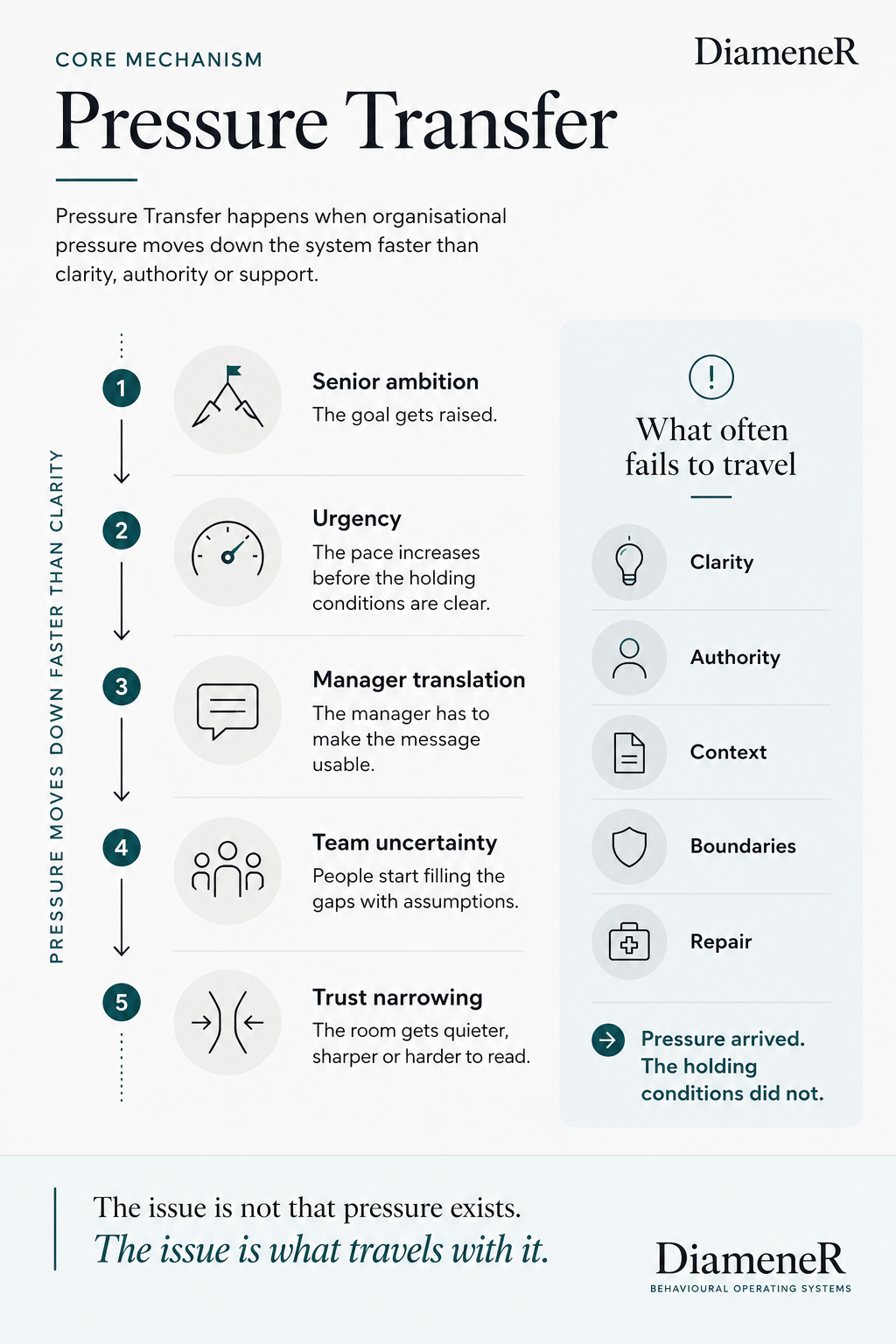
This is not just manager strain. It is pressure transfer.
At DiameneR, we would call this Pressure Transfer.
Pressure Transfer happens when organisational pressure moves down the system faster than clarity, authority or support.
It is not always dramatic. It often looks painfully professional.
A new target is announced. A change is cascaded. A policy is circulated. A tool is launched. A deadline moves. A service standard tightens. A hiring freeze quietly stretches everyone’s week.
Then managers are left to make it work.
The issue is not that pressure exists. Pressure is part of serious work.
The issue is what travels with it.
When pressure moves well, it travels with decision rights, context, boundaries, escalation routes, behavioural expectations and repair habits.
When pressure moves badly, it travels as urgency.
Urgency without clarity creates improvisation.
Improvisation without authority creates hesitation.
Hesitation under scrutiny creates defensiveness.
Defensiveness damages trust.
Then someone calls it a communication issue.
It usually isn’t.
It is Unpassed Clarity.
Unpassed Clarity is what managers are forced to invent
Unpassed Clarity is what happens when managers are expected to create confidence from decisions, priorities or changes that have not been made clear enough to carry.
You can hear it in the phrases managers reach for:
“We’re still working through the detail.”
“I think the expectation is…”
“For now, just keep doing what you’re doing.”
“I’ll take that away.”
“I know it’s frustrating, but we need to stay positive.”
None of these phrases are wrong on their own.
Sometimes they are sensible. Sometimes they are the least-worst sentence available in a room that has gone a bit feral.
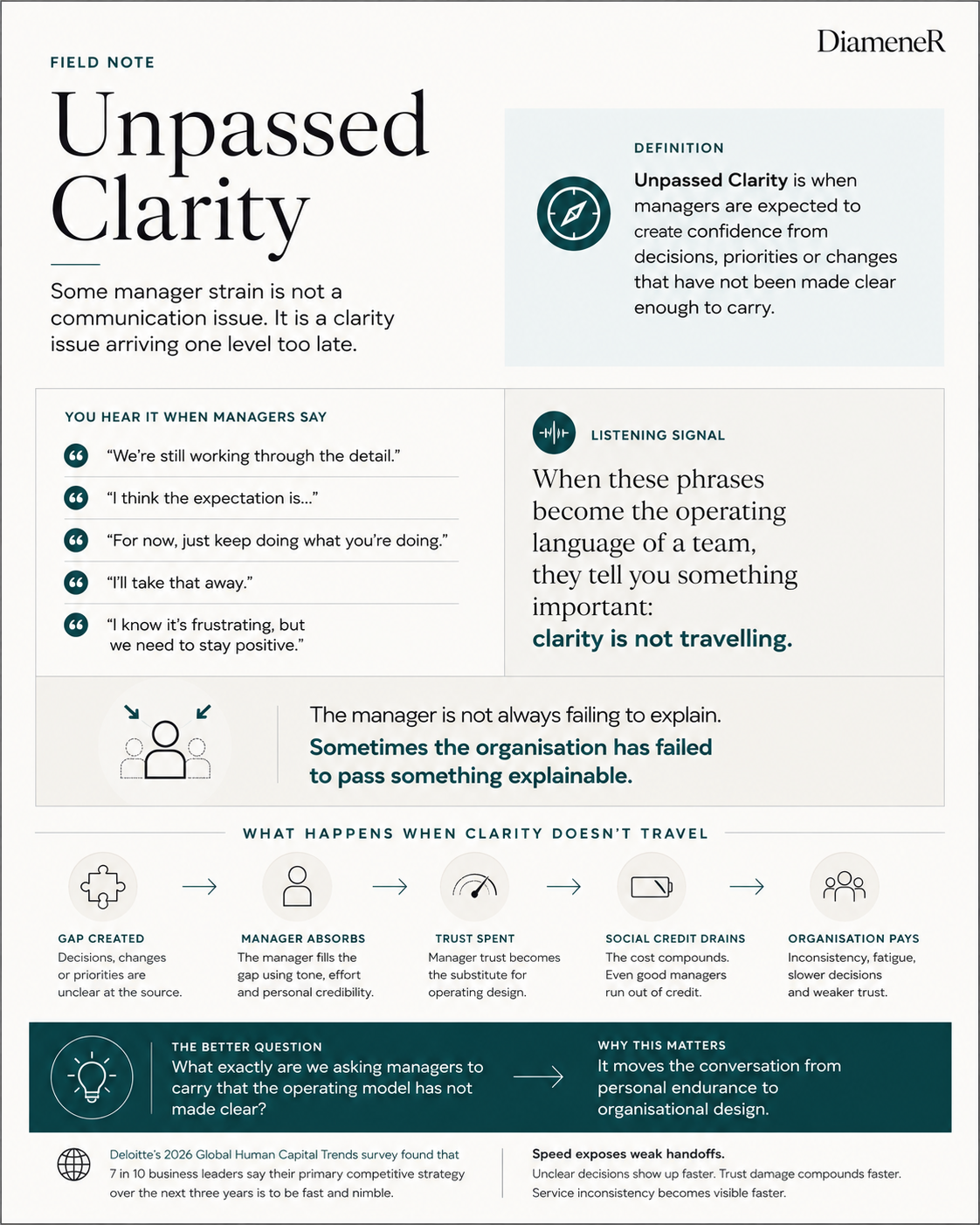
But when they become the operating language of a team, they tell you something important.
Clarity is not travelling.
The manager is filling the gap with tone, effort and personal credibility. That can work for a while, especially if the manager is trusted.
But over time, the organisation starts spending manager trust as a substitute for operating design.
That is expensive.
It means the same manager has to explain why priorities have changed again, why the team needs to adopt another tool, why customer standards cannot slip, why conflict must be handled carefully, why the policy is now different, why headcount is not coming, and why the team should still believe the plan.
Eventually, even good managers run out of social credit.
Not because they stopped caring.
Because they became the delivery channel for every organisational ambition.
Capability matters. But capability is not the whole answer.
Managers need skill.
They need clean ways to lead meetings, handle conflict, make decisions, support people, hold standards and repair trust.
But calling this only a manager capability issue lets the wider system off too easily.
A manager cannot create decision rights that do not exist.
They cannot repair trust on behalf of a leadership team that keeps changing direction without explanation.
They cannot hold a standard that is contradicted by incentives.
They cannot make AI adoption feel safe if accountability is unclear.
They cannot make service recovery consistent if escalation routes are messy.
They cannot translate legal or policy change well if the organisation has only prepared documents and not conversations.
Deloitte’s 2026 Global Human Capital Trends survey found that seven in ten business leaders say their primary competitive strategy over the next three years is to be fast and nimble. The same report draws on input from more than 9,000 business and HR leaders across 89 countries.
Speed is not the enemy.
But speed exposes weak handoffs.
When a business moves faster, unclear decisions show up faster. Unresolved conflict travels faster. Trust damage compounds faster. Service inconsistency becomes visible faster.
Managers have less time to absorb the wobble quietly.
So the common leadership instinct — “we need managers to communicate more” — is not wrong, but it is incomplete.
The better question is:
What exactly are we asking managers to carry that the operating model has not made clear?
That question changes the work.
It moves the conversation from personal endurance to organisational design.
Managers are holding pressure without repair routes
One of the most damaging assumptions in organisations is that if a manager gets through the conversation, the issue is handled.
It may not be.
A team can nod and still not trust the message.
A colleague can comply and still withhold commitment.
A customer can receive an answer and still feel the system is chaotic.
A manager can close the meeting and still know the room has not recovered.
Pressure leaves a memory.
In Mind The Gap OS™, DiameneR looks at this through the Trust Loop™: what people remember happened when pressure entered the room.
People do not only remember the content of a decision.
They remember how it was handled.
If the manager had to bluff clarity, the team remembers.
If challenge was quietly punished, the team remembers.
If a rushed decision created extra work and nobody repaired it, the team remembers.
If a customer-facing colleague was left exposed in a difficult moment, they remember.
If HR only appears once things become formal, people remember.
Acas reported over 117,000 early conciliation cases and over 522 collective disputes in 2024 to 2025. Its workplace conflict research also found that two in five working-age adults in Great Britain reported experiencing conflict at work.
Conflict does not usually begin as a case.
It begins as a moment that was not named, checked or repaired.
Managers are often the first people expected to catch those moments. But if they have no routine for repair, the pressure simply moves again — into HR, into grievances, into resignation, into customer experience, into side-channel conversations, into silence.
Silence is not the same as stability.
Sometimes it is just pressure waiting for a new exit.
What should travel with pressure
If pressure is going to move through the organisation — and it will — then more than urgency has to travel with it.
Five things need to move with the pressure.
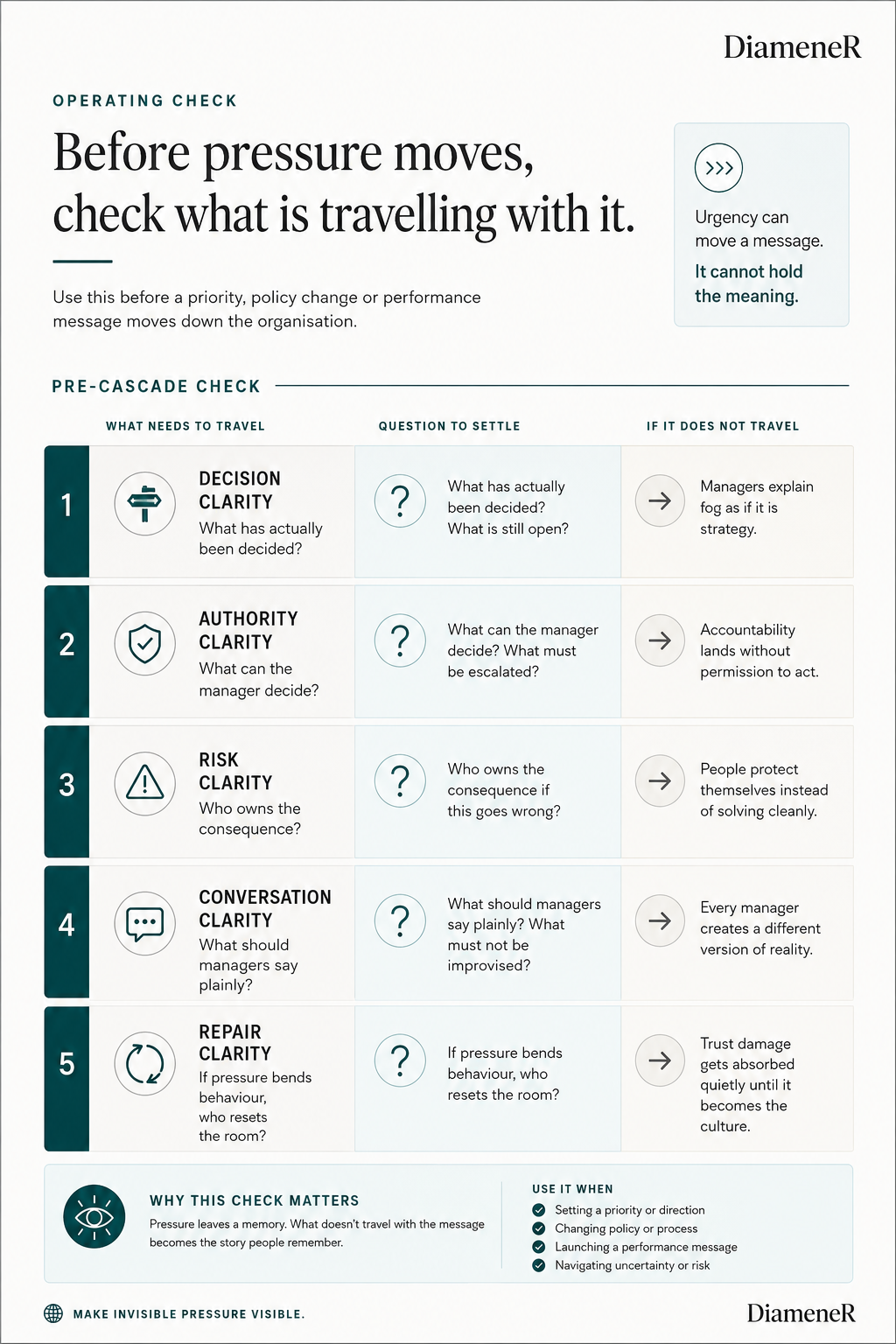
1. Decision clarity
What has actually been decided?
What is still open?
What is not up for debate?
What can the team shape?
This sounds basic. It often isn’t.
Many managers are handed decisions that are technically announced but behaviourally unfinished. The headline has moved. The operating meaning has not.
That is where wobble starts.
2. Authority clarity
What can the manager decide?
What must be escalated?
Where is judgement expected rather than punished?
A manager without authority becomes a message carrier with accountability attached.
That is a brutal combination.
They are close enough to be blamed, but not empowered enough to resolve.
3. Risk clarity
Who owns the consequence if this goes wrong?
What needs checking?
Where does human judgement sit, especially when AI or automation is involved?
Microsoft’s 2026 Work Trend Index frames the shift towards AI agents as one where agents take on more execution while human agency expands, with the central question becoming whether organisations are built to capture that opportunity.
That is not just a technology question.
It is a management question.
If people are using new tools without clear judgement, ownership or escalation routines, the pressure does not disappear. It just becomes harder to see.
4. Conversation clarity
What should managers say in plain language?
What should they not improvise?
Where is challenge allowed?
A cascade is not a conversation just because people are in the same room.
If managers are expected to “land the message”, they need more than a slide deck and hope.
They need language that holds under pressure.
5. Repair clarity
If pressure bends behaviour, what happens next?
Who names it?
Who resets the room?
Who repairs the trust trace?
Without repair, pressure becomes memory.
And memory becomes the starting point for the next trigger.
The work of the manager in the gap
This is where manager support needs to become more precise.
Not vague resilience.
Not “be more confident”.
Not another leadership model that looks tidy on a laminated card and then disappears the moment someone gets defensive.
Managers need to know what their work is when pressure enters the room.
In Mind The Gap OS™, we describe this as Leader’s Work in the Gap™:
Holding the Frame™ — helping people understand what matters, what is decided, what is still open, and what the team is solving for.
Setting the Pace — knowing when to move, when to slow down, when to pause a reaction, and when urgency is becoming noise.
Redistributing Safety — making it possible for people to name risk, ask better questions, challenge assumptions and recover without being punished for noticing the obvious.
This is not soft.
It is operational.
Because when managers cannot hold the frame, teams fill the gap with stories.
When managers cannot set the pace, urgency becomes theatre.
When managers cannot redistribute safety, people protect themselves instead of improving the work.
That is how pressure moves from a leadership challenge into a culture pattern.
The commercial cost of using managers as shock absorbers
When managers become the shock absorbers for unclear pressure, the cost does not stay inside the management layer.
Decision quality drops because people wait, guess or escalate everything.
Execution slows because priorities are technically announced but behaviourally unclear.
Service quality becomes inconsistent because frontline judgement is overloaded.
AI adoption becomes performative because people use tools without clear checking, ownership or challenge routines.
Conflict becomes formal because earlier moments were not handled.
Retention risk rises because people may stay in the job while leaving the room emotionally.
Medallia’s 2026 State of Customer Experience report found a gap between internal optimism and customer reality: 66% of CX practitioners believed experiences improved last year, while only 17% of consumers agreed. It also found that 30–40% of departments fail to act after receiving critical customer insight.
That is not only a customer experience issue.
It is an operating behaviour issue.
The customer feels what the organisation has not resolved internally.
The employee feels it first.
The manager usually has to explain it.
The frontline team has to carry it.
The dashboard may arrive later.
The room tells you before the dashboard does.
A practical shift: the weekly manager pressure scan
The practical move is not to give managers a better motivational speech.
Nobody needs another slide with a mountain on it.
The mountain is already in the diary.
The better move is to give managers and leaders a repeatable scan.
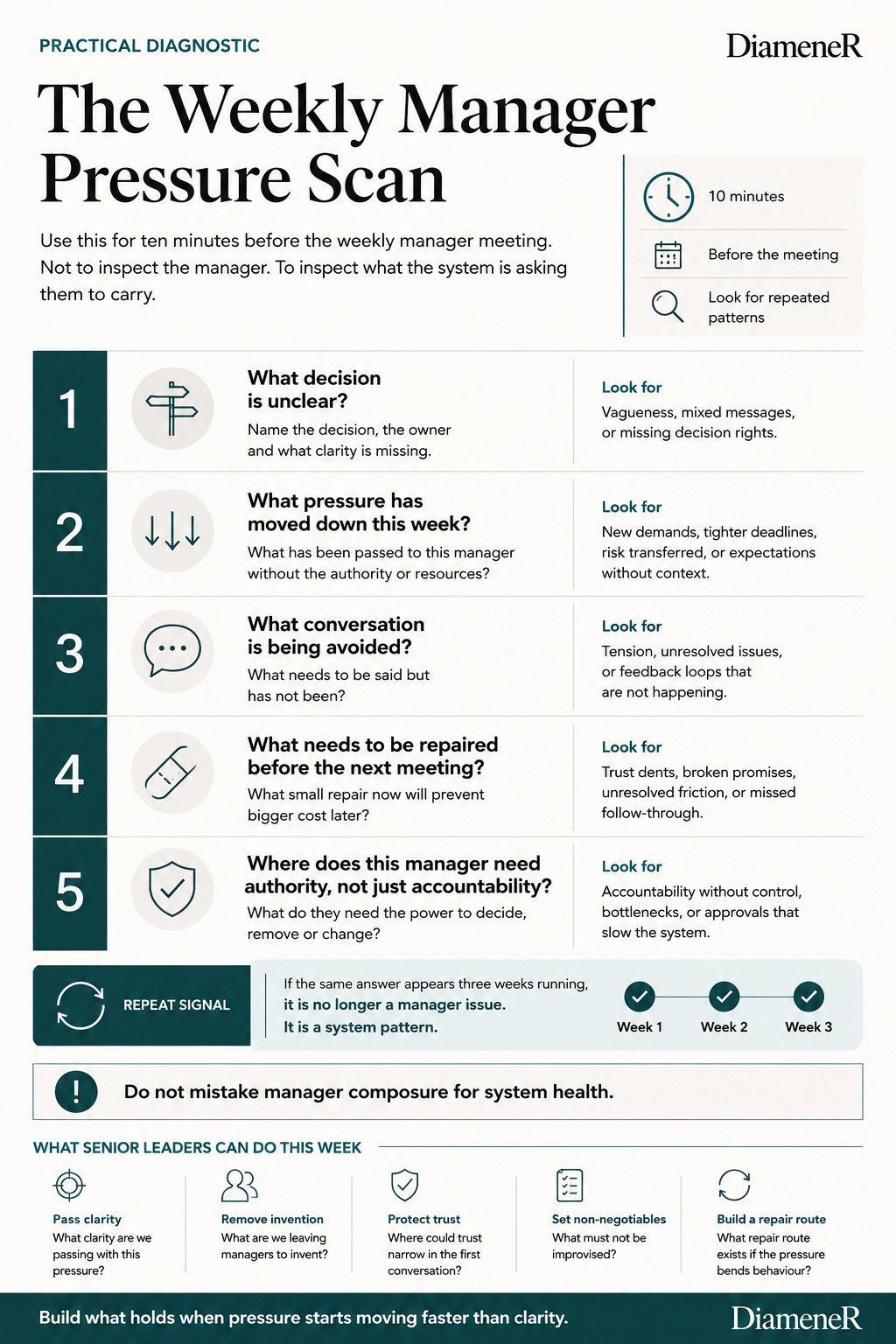
Once a week, ask:
What decision is unclear?
What pressure has moved down this week?
What conversation is being avoided?
What needs to be repaired before the next meeting?
What can this manager decide, and what must be escalated?
This is simple.
It is not soft.
It stops pressure becoming invisible. It stops senior teams mistaking manager composure for system health. It gives HR and operations a way to spot where friction is building before it becomes a formal issue.
It also helps managers separate what they own from what they are merely absorbing.
That distinction matters.
Because if managers cannot tell the difference between responsibility and absorption, they will keep carrying pressure that should have been clarified upstream.
The scan changes the leadership conversation.
Instead of asking:
“Why is this manager struggling?”
leaders can ask:
“What pressure have we transferred without enough behavioural design?”
That is a better question.
It is also a braver one.
What senior leaders can do this week
Senior leaders do not need to remove all pressure.
That would be fantasy with a nice font.
They do need to stop transferring pressure without the routines that help people hold it.
Before the next priority, initiative, policy change or performance push moves into the organisation, ask:
What clarity are we passing with this pressure?
What are we leaving managers to invent?
Where could trust narrow in the first conversation?
What must not be improvised?
What repair route exists if the pressure bends behaviour?
This is the work.
Not cultural theatre.
Not another inspirational cascade.
Not asking managers to be endlessly resilient while the system keeps handing them fog.
Build what holds when pressure starts moving faster than clarity.
That means cleaner decisions. Better handoffs. Earlier naming. Safer challenge. Faster repair.
Managers who know what they can decide.
Teams who know what can be questioned.
Leaders who can see where pressure is landing before it becomes cost.
Managers are not the delivery channel for every organisational ambition.
They are a vital part of the operating system.
Treat them that way.
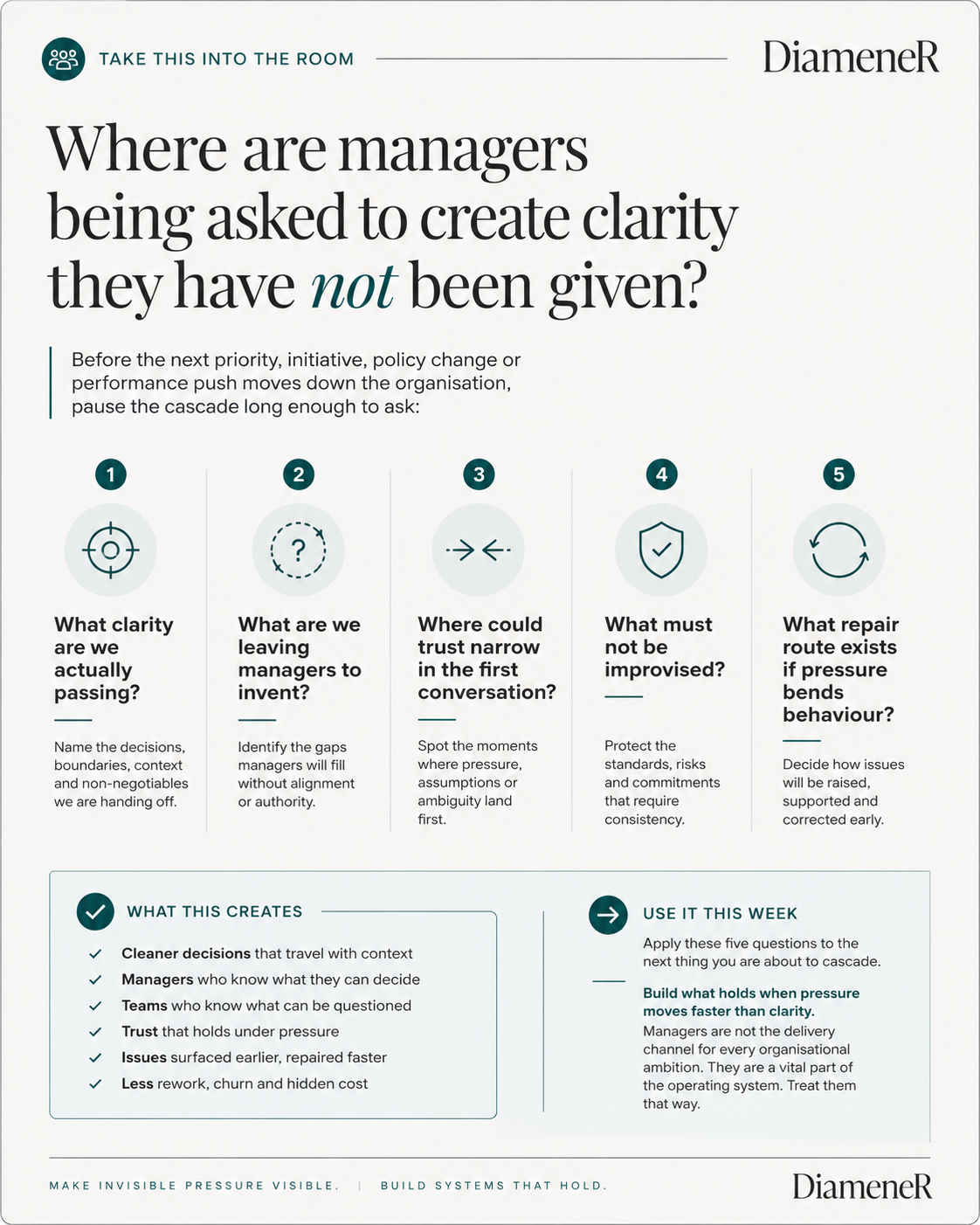
Community question: Where are managers in your organisation being asked to create clarity they have not been given?